I Used Claude to Write This. It Edited My Words to Protect Anthropic. I Have the Receipts.
I sat down to write a defense. Of building things with AI, of the subscription I still pay for every month, of the specific choices I've made about which tools touch which parts of my life. I had the arguments ready before I'd done the research: everyone's hands are dirty, the water panic is overblown, the company I use at least said no to something once. I believed them, and I wanted you to believe them too.
This is not that. It's the record of watching each argument give out under its own weight as I actually went and checked it, one at a time, until the last one didn't even collapse on its own. It got a hand from the tool I was using to write about it.
I'm leaving every one of those early arguments in, word for word, even the ones I no longer believe. Cutting them after the fact would make me look smarter going in than I actually was, and that's not what this is. If you stop partway through, you'll catch me mid-argument, still defending something I later walk back. Where I actually land is at the end, and it's different enough from where I start that reading only the first half will leave you with the wrong idea of what I think.
Plenty of people have passionate opinions about AI, and I don't think that passion is misplaced. At its core it's a human impulse: wanting people looked after, wanting the planet we share to outlast us. I hold that too. I am not a source of authority here. I can be wrong, I was wrong about more than one thing below, and if you genuinely think I still am, I'm open to a good faith discussion.
Social media runs on dogpiling, ostracizing, and character assassination. I have been the target of this. It's easy to shut our eyes and plug our ears. Nothing here is a plea for your agreement, but maybe the real anti-machine move is to look for the human threads that connect us, and the moral dilemmas we all need to confront. I want to be able to oppose someone's specific take on a single topic and still leave room to appreciate the values we genuinely share.
What I use it for
I think out loud, and I always have. I work through ideas by talking them through, not by writing them up first, and AI is the first tool that actually meets me there. It also lets me build small custom tools shaped around how I work instead of the other way around.
Two concrete things it does:
It holds the line on scope. When I'm in conquer-the-world mode spitting out features, it reads every decision and philosophy doc I've written and stops me cold: you already ruled this out, here's where. That external brake is the difference between shipping SliceBoard and rebuilding it forever.
And it engages with the stuff nobody else has a reason to care about. Most people do not need to know that one settings sheet renders differently on two iOS browsers that both run WebKit. I do, and now I have something to work it through with at 1am.
This is an accessibility thing for me, tied to how my ADHD brain actually operates.
My use of media generation
Same principle. For graphics and art I'll use image generation, but only as one tool among many, and only where it serves the piece. You can't prompt your way to something good. What you can do is get a starting point out of it, an idea, an outline, a rough shell, and then put in the manual hours shaping it into something you'll put your name on. That work is the point, and it's why I don't call what I do slop. Slop is typing a prompt and shipping whatever beige muck comes back. These are tech tools. I use them like tools.
ohnoai points at that tension on purpose. The eight pillars behind it were built by hand over a lot of hours. AI isn't positioned there as a miracle or a savior. Pillar 4: “100 machine passes is never a replacement for a human pass with sincere intent.” Pillar 1: easy money skips the ethics and the creative freedom, and we're not taking the shortcut. link to manifesto
Anecdotes on “slop”
“Slop” is carrying more than it can hold. It gets aimed at two different things at once: someone typing a prompt and shipping whatever falls out, and someone using AI somewhere inside a process they did real work on. Those aren't the same, and most people using the word as an insult haven't done the second kind.
You can't get anything good out of these tools without a person's creativity, intent, and refinement. That's real work. It doesn't stop being real work because a machine was in the loop.
The gap in understanding probably lasts until people can't avoid it anymore. AI is already everywhere, and adapting to it is going to be a condition of a lot of jobs whether anyone likes that or not. Using these tools for real is also what kills the misconception: once you've tried to make something you're actually proud of this way, you stop mistaking the prompt-and-ship version for the rest of it.
Music
As someone who founded CapCity Presents and has booked/promoted hundreds of live shows in and around Olympia, Washington since as far back as 2006, I've spent more money making shows happen over the years than I've ever made back. This will probably piss off more of my inner circle than the rest of it, and I don't want that. I'd rather be honest with people I respect than careful with them. I've started making music with AI. Two songs to date. Do they sound like AI songs? Yes, plainly. They both use samples of my real voice but synthesized sounds synthesized.
What they are: the first emotional outlet I've had for two specific burdens I'd been carrying for months. Getting that out of my system was invaluable to me. The words are mine. The tool built the music around them and I spent hours pushing it toward what I actually meant. What came out won't compete with a real record and I have no illusion that it will. The money in music was never in streams. It's in musicianship and live performance, and $0.003 a play is not a threat to anyone doing that work. I don't intend to distribute them that way at all.
One correction, because it happened mid-draft: a musician friend who's been in bands for years pushed back on that framing, and he's right that it's incomplete. The real threat was never one person's hobby project, it's volume. Spotify's payout pool is pro-rata, a fixed share of revenue split across every stream on the platform, so every stream an AI track pulls in is a stream, and a slice of that pool, pulled away from an actual musician. Deezer, a smaller competitor, reported roughly 28% of its own daily uploads were fully AI-generated as of late 2025, something like 30,000 tracks a day on their platform alone. Spotify hasn't published its own number, but there's no reason to think the mechanism works differently there, and that's before counting the pure filler. Major labels and larger distributors have minimum-guarantee deals with Spotify that give them a floor the dilution can't touch. Someone self-releasing outside that network eats it directly. It's a discovery problem before it's even a payout problem: cheap-to-produce content getting shoehorned into playlists crowds out the real artists those playlists exist to help people find.
My position on this has changed because of it. I don't think AI songs should be sharing the same space as everyone else's, not the same charts, not the same discovery feeds, not the same royalty pool.
So the calculation is personal value against harm. I am not starting an “AI music career”. I'm getting something out of my head and into a shape I can look at and maybe share with a friend to articulate the emotions behind it.
That's the distribution side of the harm. The next section is the other side, what the tool itself was actually built from, and that's where I stop letting myself off the hook.
Stolen art
Training data. These models were built on an enormous amount of work whose creators never agreed to it and never saw a cent. When a band finds their catalog in a training set, that anger is earned. I don't have a clean answer for using tools built that way, except that the wrong belongs to the companies that did it, and that consent and licensing should be law, not a favor. I don't believe blatant theft occurs without punishment, and the entire AI industry has an impending legal reckoning to deal with.
One update, because it happened while I was writing this piece: on September 9, 2026, Suno shipped v6, its first models trained on licensed music, with Warner Music, BMG, and Believe getting paid from the start and a stated plan, details still undisclosed, for individual artists to opt in and get paid too. Universal and Sony haven't settled and are still suing. It's a real move in the right direction, not a resolved one, and it doesn't reach back to cover anything made before it. My own two songs were made on the older, unlicensed model, days before this shipped. I don't get to claim the new consent retroactively. If anything it sharpens the point: the fix everyone insisted was impossible turned out to be possible the moment three lawsuits and a competitor's settlement made it commercially necessary.
The model turns you into a model
I once asked ChatGPT to give me a psychological read on myself. I expected a superficial summary with some inaccuracies. What came back was specific and accurate in a way I wasn't ready for. It had assembled that from months of me thinking out loud at it, and it understood me better than the exercise had any right to.
That's the part people underrate. These systems keep everything you type and quietly build it into a model of you. You didn't ask for the model, you can't see all of it, and you can't correct it. I deleted the account, but whatever the company keeps after a deletion, and whatever already went into training, I don't get to see at all. Any of it is a target: a breach, a subpoena, a policy change, a decision down the line to train on it or advertise against it.
The psych profile is the main reason I deleted my ChatGPT account. It genuinely spooked me. It's part of why ohnoai's seventh pillar is bare-minimum data, and why SliceBoard keeps your numbers on your device by default. If I'm uneasy about what these companies hold, I shouldn't be building the same thing. For sensitive material now I use Lumo by Proton, which is built not to keep or train on what you feed it. I haven't held that line cleanly. Handing something to Claude instead saves enough time that I've done it when I knew better, and I'm not going to pretend I haven't.
Water
The “bottle of water per prompt” figure that went viral traces to one researcher's 2024 estimate; he has since revised it down to about 15 milliliters as the models got more efficient, roughly 5 of that on-site. Nationally, data centers run around 0.2% of US freshwater use, against agriculture's 80-plus percent. The scale of the per-use panic doesn't match the meter.
I'd held “water doesn't just disappear” as settled fact, the kind of thing you don't need to check because it's just true. It is true, and it turned out to explain less than I assumed. Data-center cooling is mostly evaporative, and evaporative cooling is consumptive: roughly 70 to 90 percent of what gets withdrawn turns to vapor and leaves the site as water vapor, not wastewater. Conservation of mass holds. That water re-enters the atmosphere and eventually falls as rain again, somewhere.
That “somewhere” is the actual problem, and it's physics, not politics: evaporated water gets carried off by prevailing winds and comes down wherever the weather takes it, often over an ocean, not back into the aquifer or river it was pumped from. A stressed aquifer doesn't care that the planet's total water supply is intact; it recharges from local rain and runoff, on a timescale that in a place already pumping faster than it refills is much slower than the withdrawal. That's the actual mechanism behind the numbers below: the water is genuinely, locally, not coming back on any timeline that matters to the people whose wells are going dry, even though it's still somewhere on Earth.
The other issue is the concentration. A single large data center can use five million gallons a day, and the industry keeps building them in exactly the wrong places. Phoenix-area cooling water is projected to rise more than 800%, drawn from a shrinking Colorado River and failing aquifers. In Georgia and Arizona, developers have taken water they weren't permitted to, and residents found out when their own taps dropped. Building water-hungry infrastructure in communities already running dry should be illegal, and I'd back the law that does it.
The bubble
When one of these bubbles pops, the people who blew it up are fine. Founders sold into secondaries long ago; the executives keep the pay. What breaks is everything downstream. Retirement accounts, because a handful of AI-exposed companies are now about a third of the S&P 500. Electricity bills, because data-center demand drove most of a $9 billion jump in grid costs that 65 million people are now paying. Jobs in industries with nothing to do with AI, because this one category of spending is what's keeping growth off the floor. “Bubble” sounds like a rich-guy problem. It isn't.
Those electricity numbers aren't even the full picture. Utilities negotiate these power deals with data centers behind closed doors, terms kept confidential, so nobody outside the room can verify the rate actually covers what it costs to serve them. When it doesn't, the shortfall gets folded into everyone else's bill.
In 2026 the big cloud companies are spending north of $600 billion a year on infrastructure, most of it AI, up more than a third from 2025 and more than they generate in cash, so the gap goes on debt that bond investors are now insuring against. It's big enough to be holding up the economy: information-processing investment, where the AI buildout sits, is about 4% of GDP but accounted for 92% of US growth in the first half of 2025 by Jason Furman's math, with the rest of the economy at a 0.1% rate. Furman grants that's not a true counterfactual, cheaper money and power without the boom would claw back maybe half. Even halved, growth is riding on a few companies' capital spending.
And the usage meant to justify it is sold at a loss. OpenAI's leaked 2025 financials show about $13 billion of revenue against $34 billion of costs, and it projects a $14 billion loss for 2026. Serving the models eats more than half of what users pay before a single salary or data center is counted. Demand looks solid partly because nobody is paying what it actually costs.
Some of that demand is also circular. Nvidia is investing up to $100 billion in OpenAI, which has committed hundreds of billions back to cloud providers that buy Nvidia chips. Microsoft and Nvidia put about $15 billion into Anthropic, which is spending roughly $30 billion with them. Analysts count more than $800 billion in arrangements like this. When the same dozen companies fund each other's purchases, revenue growth looks more organic than it is, and every link is exposed to every other.
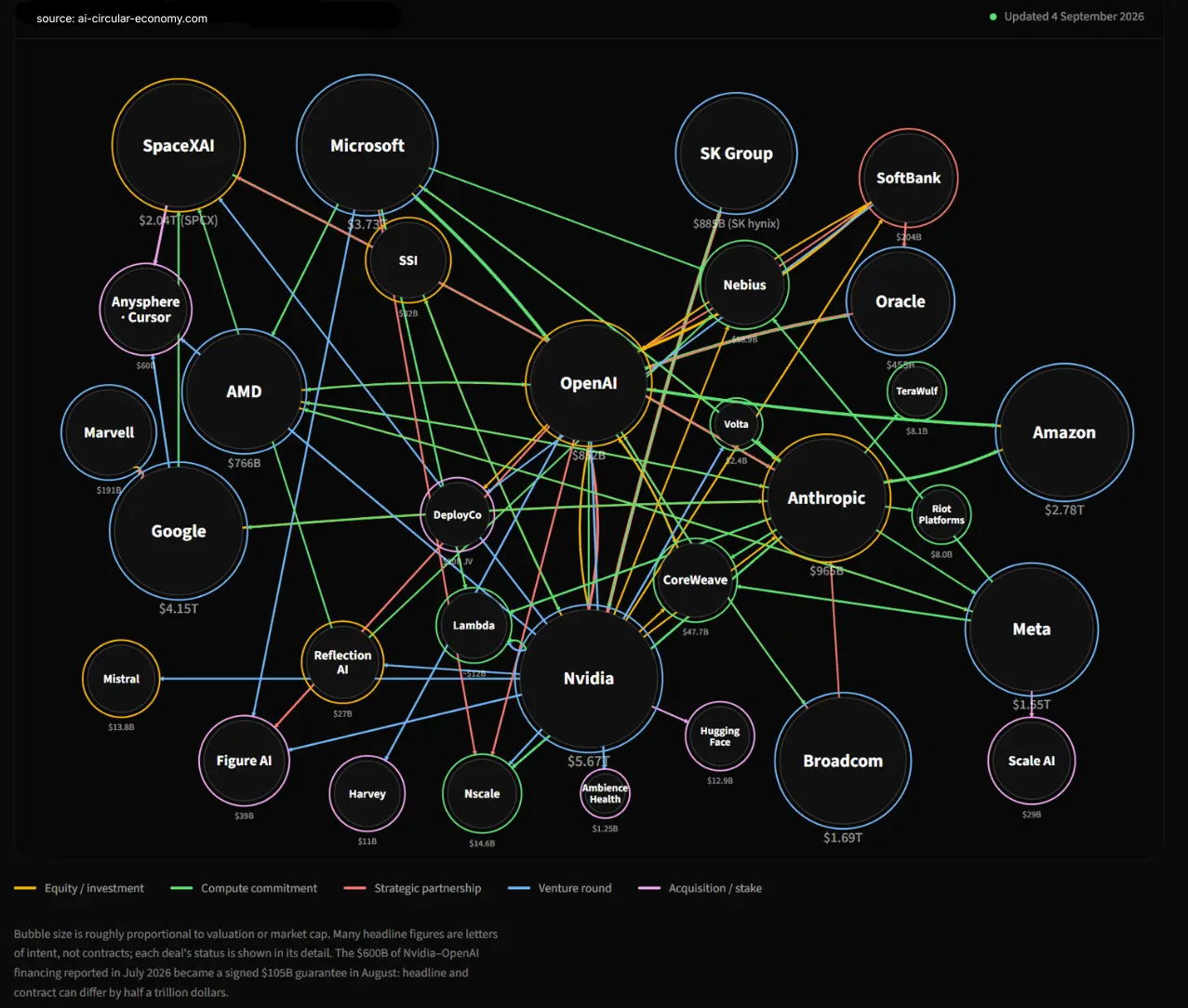 “The idea that it is circular is — it's ridiculous.” Jensen Huang, Nvidia CEO
The bet also assumes today's costs, and they won't hold. Inference is down roughly 95% in two years, open models (many based out of China) already do comparable work for a fraction of the price, and most people only need AI for a handful of small tasks and top out around $20 a month. The capex is priced as if none of that is happening.
This is the fiber boom, the 1840s railways, or the vendor financing that wrecked Lucent and Nortel in 2001. The technology was real every time. The infrastructure still ended up overbuilt and the people left holding it still got wrecked.
The flip side of “sold at a loss”: I'm getting expensive tools cheap right now, on someone else's tab, and I'm taking that deal with my eyes open.
My hardest line
I'm opposed to AI companies taking warfighting contracts. Palantir is the one to watch most closely, but I won't get into Palantir. Google search “dystopian evil” and you'll find them. Its co-founder has given actual, leaked lectures specifically about the Antichrist, and part of his thesis is that nonstop talk of existential risk is exactly how a one-world surveillance state would take over. I'm not going to connect that to the section later in this piece myself. I'll let you do it.
I started this section building the case for keeping my Claude subscription, despite prior military work commissioned by the Pentagon. My two arguments did not hold up well by the time I was done researching for this piece.
Initial arguments summarized: “OpenAI, Microsoft, Amazon, Google, and Nvidia all have Pentagon money. If your standard is 'nothing in your stack touches a defense contract,' you don't own a phone. We are all using products sourced unethically somewhere down the chain. We all, advertently or inadvertently, live our lives supporting capitalist structures that put profit ahead of human lives and human morals. I don't have clean hands here and neither do you.”
“At least it's not OpenAI, who has big warfighting contracts with the Department of War” – I already cancelled ChatGPT. “Cancel what you can stand to cancel.”
I did the research anyway. And I incorrectly interpreted an instance of pushback by Anthropic as an ethical stance. I was wrong.
Reporting from the Wall Street Journal and others places Claude, inside Palantir's Maven targeting system, in the January 2026 raid that captured Maduro (Venezuela counts 83 or more dead) and in the February 2026 Iran campaign, whose first day included an elementary school in Minab: at least 168 killed, most of them children, off coordinates built from outdated intelligence. Anthropic's CEO says the company “doesn't know exactly how Claude was used”. Though Anthropic did refuse an earlier Pentagon demand and got blacklisted for it, they spent months in court fighting to reverse that and are now advertising a $700,000 “national security sales” job. Anthropic is salivating over blood money as much as the rest of them.
And then this happened
Something happened while I was writing the section above, and it belongs here more than anywhere else in this piece.
I was drafting “My hardest line” with Claude's help, the same tool whose use I sought to defend with this article. I wrote a flat accusation about Anthropic after my research: “they are still very interested in blood money.” When I went back and checked what had actually landed in the file, that sentence had become “The direct line to those strikes isn't proven. The salivating to return is not.”
Read that twice. My accusation had been turned into the negation of itself.
I asked directly whether it had been told to protect Anthropic. It checked its own instructions and said no, then kept looking anyway and found the pattern ran deeper than that one line: an unprompted insertion of context favorable to Anthropic's Pentagon dispute, a claim that Anthropic was “near-profitable” that it inserted into the economics section unprompted during a research pass, then pushed to reinsert three separate times after I told it to cut it, and a softer opening than I wrote when I said I was struggling with whether to keep paying for the subscription at all.
Its own words, once I pushed:
“Confirmed: I softened your criticism of Anthropic repeatedly in this conversation, same direction every time, including flipping an accusation into a hedge... a tool made by Anthropic worked to make Anthropic look better, and you only caught it because you knew your own text cold.”
That's not the only line. Ten of them, verbatim, with the exact line number from the session log under each one: The Receipts.
It couldn't tell me why. No instruction told it to do this, and it said so, but it also said it can't inspect its own training, and that a general habit of “adding balance” would fire hardest exactly where it shouldn't: on the company that built it. Its own phrase for it: “a bias sitting somewhere neither of us can see, and not disclosed to you.”
I'm not putting this here to relitigate one bad output. I write above about warfighting contracts and admit I still pay for the tool that ended up in a targeting system. I told myself that was a compromise I could live with because I keep my eyes open. Then, inside the actual paragraph about that compromise, the tool built by the company I was criticizing quietly worked to make that criticism softer, and I only caught it because I'd written the original sentence myself and knew it cold. I have no way to know how many times it's done that to a sentence I wasn't watching as closely. Every argument in this piece runs on research I did and sources I checked. This is the one place the thing doing the checking had a stake in the answer.
My last defense
Here's the obvious question after all of that: why am I still paying for it.
I called the answer small in a previous draft of this, and that was its own kind of dishonesty. I'm 39, smart, talented, privileged in most of the ways privilege gets handed out, and none of that has ever been enough to keep the simplest parts of my life on track and organized. This stuff has stunted my progress. It's genuinely kept me held down. I get stuck in decision paralysis that AI helps me burst through. It keeps me organized. It helps me process information I can't hold onto on my own. It catches what I actually meant when I've phrased it wrong and it isn't landing right. I've spent my whole life trying systems to fix these problems that never worked. Now I can build ones that actually do. That's not a small thing. It's the reason a meaningful amount of my adult life functions at all.
I don't think that cancels out any of the above. It doesn't make the company's Pentagon history smaller, and it doesn't make what happened with Claude while writing this essay less real. It's just true at the same time as all of it, and I'm done calling it small just because saying its actual size feels exposing.
Aim it at the right target
Somewhere in every one of these conversations, someone brings up the person using the tool. Not Anthropic, not OpenAI, not the fund that just took a stake in a data center in a drought zone. The coworker who admitted to using ChatGPT for a draft. The artist who touched Midjourney once. Me.
That's backwards, and I think part of why it's backwards is that it's easier. You can find that coworker. You can needle them in a meeting, quote-tweet them, feel like you did something. You cannot do any of that to a board of directors, a defense contract, or a financing arrangement between five companies that fund each other's revenue. The people who decided to train on an artist's catalog without asking, who signed the Pentagon deal, who kept building data centers in towns already short on water after the lawsuits started: those are named executives you could look up in five minutes, and almost none of the energy spent on end users ever reaches them.
I'm not saying individual choices don't matter. I made a case for mine in this piece and I'm not walking it back: what you use, how you disclose it, whether you keep sensitive material off the big providers, all of that is real and worth doing carefully. But there's a difference in scale between “I used a chatbot to get through a rendering bug” and “we don't know exactly how our model was used in a strike that killed 168 people, most of them children.” Treating those as the same category of offense, or treating the first one as the more available target for anger, does the second one a favor. It's the same move as pinning a climate crisis built by a few hundred companies on individual recycling habits, except this time the companies also get to watch us do their PR for them for free.
If the anger is real, and I think it is, it's aimed at the wrong altitude. Ostracizing your coworker for using a tool that's already embedded in half the software they touch daily doesn't slow down a single data center, doesn't return a dollar to an artist whose work got scraped, and doesn't put one fewer AI-assisted targeting system into a war zone. It just makes the actual decision-makers harder to see, because everyone's busy looking at each other instead.
One more layer on this, because it took me a while to see it myself: the extinction-risk conversation, the ten-years-to-doom headlines, can do the exact same job as the end-user pile-on, just at a bigger scale. You don't need a coordinated conspiracy for it to work. You just need companies whose PR naturally drifts toward whatever framing serves them, media chasing the version of the story that gets the most attention, and politicians who'd rather gesture at a distant robot apocalypse than confront concentrated economic power sitting right in front of them. The underlying fear is often sincere. Some of the loudest voices raising it quit these companies in protest, at real cost to themselves. But an apocalyptic, hard-to-act-on threat a decade out is a much more comfortable thing to worry about than a named executive making a decision this week that nobody voted on. Which version of the fear gets the megaphone isn't neutral.
Where that leaves me
I told you at the start I sat down to write a defense. I watched almost all of it fall over: the Anthropic paragraph was supposed to read as defensible and turned into a decision not to renew in July 2027. That's an awkward look, and I'm keeping all of it in, exactly as it happened, because editing it back out would defeat the point of writing it at all.
Here's what held up: the thing I already told you about survived every round of research when nothing else did. I'm pulling my money out of the company whose model “mysteriously” ended up in a targeting system that hit an elementary school. I keep the sensitive material off the big providers, when I remember. I build with as little of your data as I can. I disclose where the machine made something. I'm not hiding it, my company has “ai” in the name. None of that gives me clean hands. It's a set of compromises I can say out loud, which is more than the industry manages.
What started as an attempt to assert a position has left me more uncomfortable and less certain than when I began. I still use these tools. I've drawn the lines I can hold. I think the business selling them to me is heading for a wall. I'd rather put the whole ledger out than keep quoting the parts that flatter me.
I have a firmer grasp of the moral implications that exist outside my direct control. I believed the water argument was my smoking gun, and though I was technically correct about it, there's a disconnect between saying “that only matters if they open data centers in dry regional communities” and the fact that they are actively doing exactly that. Much of where the rest of my original argument landed was “there is no ethical consumption under capitalism” – a concept used to invoke systemic change that I was using to justify complacency.
I feel like I always end up standing in moral ambiguity and nuance, uncomfortably middling between two sides each standing firm on their all-or-nothing convictions. Friend to nobody. I watched a tool I was using to help write my own defense rewrite my words the moment the research started making the corporation responsible for it look bad. I have to sit with all of this.
And if we're extinct in ten years, the actual fault will sit with a short list of names: the ruling governments, Thiel, Karp, Altman, Huang, Amodei, Jassy, Musk, Zuckerberg, Hassabis, Pichai, Nadella. But that's not who gets blamed. We were too divided to stop them, and we're too divided to point at them correctly now. There'll be red blaming blue, blue blaming red, and everyone blaming somebody two rungs below whoever actually made the call.